
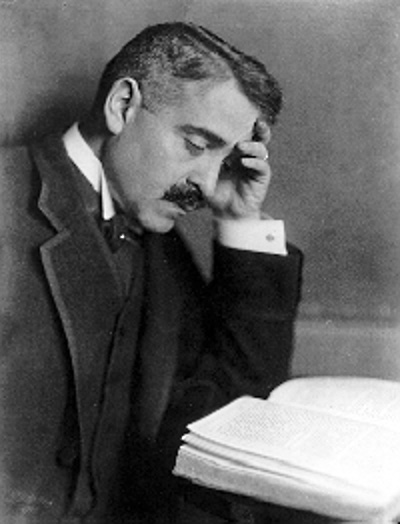
Aby Warburg was born into a banking family and chose books.
The familiar family story says that as a young man he surrendered his place in the banking business to his brother Max on the condition that Max would buy him every book he wanted for the rest of his life. Stories repeated for long enough tend to become smoother than events, but the bargain captures something true about Warburg’s appetite. He did not collect books as decoration. He wanted enough of them to build a method.
His subject was difficult to name because he did not respect the borders that made academic departments comfortable.
“Collections require escape plans.”
He studied Renaissance painting, classical antiquity, astrology, ritual, religion, memory and images that survived long after the societies that first gave them meaning had disappeared. The library grew around these questions.
Its arrangement was part of the argument.
Warburg resisted the ordinary logic of putting similar books together simply because librarians agreed they belonged to the same discipline. The Warburg Library developed what became known as the principle of the “good neighbour”. The useful book might be the one beside the book a reader had gone looking for. Philosophy could illuminate art. Astrology could sit near astronomy. Ritual could explain an image that formal art history could not.
By the 1920s the private library had begun turning into an institution.
Warburg had been joined by Fritz Saxl, who helped make the collection into a research institute, and by Gertrud Bing, who became one of its central intellectual figures. In 1926 a purpose-built library opened in Hamburg with an elliptical reading room. The books were broadly ordered across four great categories: Orientation, Image, Word and Action. The categories were expansive enough to hold a history of culture rather than one academic subject.
Warburg died in 1929.
Four years later the question was no longer how the books should be arranged.
It was whether they could remain in Germany.
The Nazis came to power in January 1933. The Warburg Library was Jewish in origin, international in outlook and attached to a family that had become impossible to separate from the racial politics of the new state.
The response was practical.
Move the library.
In December 1933, roughly 60,000 books, together with photographs, slides and furniture, were packed into 531 boxes. Two small steamers, Hermia and Jessica, carried them down the Elbe on 12 December. The Warburg’s own account records the strange final scene in Hamburg. In the empty elliptical reading room, Warburg’s widow served tea on temporary boards and trestles to the anti-Nazi workers who had packed the collection.
The books reached London.
This sentence is so simple that it can conceal what happened.
A library is one of the least portable things people build. Its meaning depends partly upon arrangement. Remove thousands of books from their shelves and you do not simply have a library in boxes. You have the pieces from which a library may or may not be reconstructed.
The Warburg was reconstructed.
It passed through temporary homes in London, received support from Samuel Courtauld, developed a relationship with the University of London and became formally part of the university in 1944. Its eventual home in Woburn Square opened in 1958. The Institute remains in London today.
The classification survived too.
Orientation.
Image.
Word.
Action.
The names still sound peculiar, which is part of their value. They remind the reader that classification is never neutral. Every library makes an argument when it decides which books belong together.
Most modern information systems try to solve this problem by becoming more exact.
A book receives categories, identifiers, keywords and relationships. Search becomes good enough that the shelf beside it appears less important.
Warburg understood another form of discovery.
Sometimes knowledge comes from proximity that nobody requested.
You look for one thing and encounter another because somebody made a judgment about neighbourhood.
This is a curatorial idea rather than a computational one, although good computational systems increasingly attempt to recreate it.
The Warburg story also contains a harder lesson.
Collections require escape plans.
Libraries and museums often appear permanent because their buildings are heavy. Institutions encourage this impression. Stone, endowments, catalogues and boards of trustees are designed partly to extend time.
History is not obliged to respect the arrangement.
In Hamburg, the most important act of stewardship was not acquiring another rare book. It was putting sixty thousand existing books into boxes before it became impossible to do so.
The collection survived because the institution understood that preservation sometimes requires movement.
That movement changed the Warburg.
It became British without ceasing to be the product of a German Jewish intellectual world. Scholars arrived from elsewhere. The Institute became one of the places through which a displaced European humanist tradition continued after Europe had tried very hard to destroy parts of it.
There is a final elegance in this.
Warburg built a library to study the afterlife of images and ideas.
After his death, the library itself acquired an afterlife.
The books crossed the sea.
Their neighbourhood survived.