
The first surprise is its size.
The Hours of Jeanne d’Évreux measures less than four inches in height. It was made in Paris around 1324 to 1328 and is attributed to Jean Pucelle, one of the great illuminators of the French Gothic court. The pages are vellum. The pictures are largely grisaille, built from delicate shades of grey with restrained touches of colour. The Met records twenty-five full-page miniatures and hundreds of marginal figures, a private world of saints, beggars, musicians, animals and strange little creatures small enough to be held in a queen’s hand.
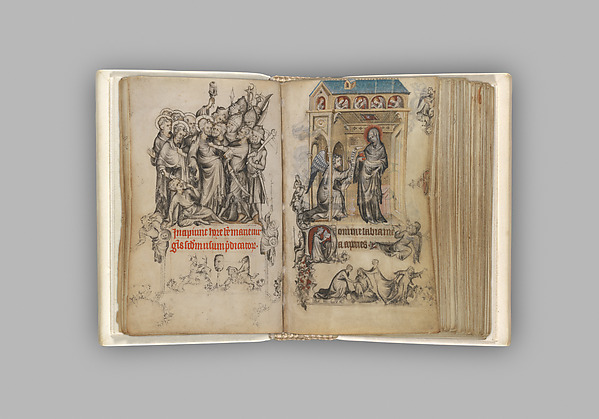
It was made for Jeanne d’Évreux, queen of France and wife of Charles IV.
“The manuscript still fits easily between two hands.”
This mattered because a book of hours was an intimate object. It organized private devotion through the hours of the day. A queen might own reliquaries, jewels, plate, textiles and estates that declared rank publicly. This book met her at prayer.
Its early provenance is unusually personal. Jeanne kept it through widowhood and in 1371 left it to Charles V of France. The manuscript later entered the collection of Charles’s brother Jean de France, duc de Berry, one of the most celebrated manuscript collectors of the Middle Ages.
Then the line becomes less obedient.
Objects often pass through periods in which their whereabouts are known imperfectly or reconstructed from marks left on them. Ownership can survive as a coat of arms on a binding, a catalogue description, an inscription, a sale record. The book eventually entered the Rothschild collections, and by the early twentieth century it belonged to Maurice de Rothschild.
Its twentieth-century history is difficult to look at as ordinary collecting history.
The Nazis confiscated the manuscript in 1940. It was taken to Germany and reached Neuschwanstein, one of the great repositories used for looted art during the war. In 1945 James Rorimer, then serving with the Monuments, Fine Arts and Archives program and later to become director of The Metropolitan Museum of Art, found the manuscript there. Met material records the extraordinary detail that it had reportedly been concealed in a wastepaper basket as German forces withdrew. It was restituted to Maurice de Rothschild in 1948.
Rorimer encountered the book again.
In 1954, when Rothschild sold manuscripts from his collection, Rorimer persuaded The Met to acquire the Hours of Jeanne d’Évreux for The Cloisters. The accession number, 54.1.2, now sits beneath an object whose previous identifiers included royal ownership, aristocratic arms and a Nazi inventory number.
This is what provenance can do when it is allowed to remain complicated.
The history of the manuscript does not merely tell us who owned it. It changes what we see. Jeanne’s possession makes the scale intimate. Jean de Berry places it inside one of medieval Europe’s great cultures of collecting. Rothschild ownership joins it to another chapter in the history of private collections. Confiscation records violence done to owners as well as objects. Restitution returns a legal and moral fact to the catalogue. Rorimer’s presence links wartime recovery to the museum that eventually acquired the book.
The object itself remains very small.
There is something almost absurd about the forces assembled around it. Queens, kings, collectors, soldiers, curators and museums have all entered its history, while the manuscript still fits easily between two hands.
Today it is preserved at The Cloisters. The pages can be studied, photographed and placed within the history of medieval art. Its images are also released by The Met into the public domain, which means a private prayer book commissioned for a fourteenth-century queen can now be examined on a screen almost anywhere in the world.
Its provenance has not finished. It has simply reached the part being written by a museum.