
A signet ring is an unusually small machine for making a person present when the person is absent.
Press the engraved face into clay or wax and a mark remains. The hand can leave the room. The mark stays behind.
The idea is ancient enough that it can be difficult to recover its practical force. We now sign documents with pens, click approval buttons, enter passwords and authorize transfers with a face or fingerprint. Identity has become increasingly invisible.
“The ring began as an object designed to make an impression. Its age is shown by the impressions made upon it.”
The signet made identity physical.
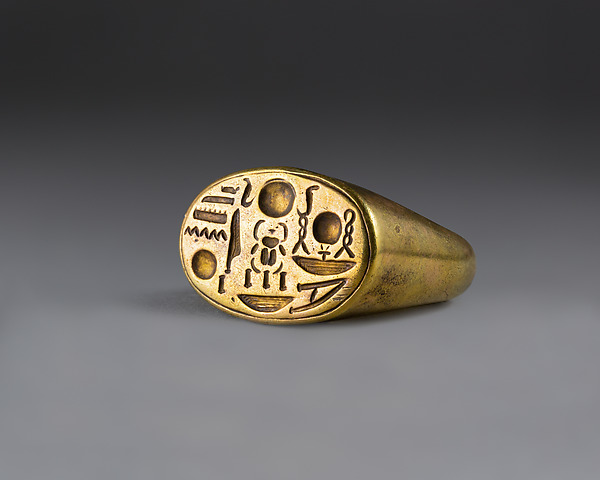
Ancient Egyptian examples make this plain. The British Museum holds a gold signet ring associated with Sheshonq whose bezel could be pressed into mud to seal documents and objects. The Met preserves a gold ring carrying Tutankhamun’s throne name that shows wear from repeated use as a seal. These were ornaments, but they were also instruments.
A ring was particularly well suited to this work because it remained attached to its owner.
Keys are put down. Seals are misplaced. A ring is worn.
That intimacy gave the signet a peculiar authority. The engraved image, name, monogram or arms had a legal and social life that extended beyond decoration. Some precious metal signets bearing a ruler’s name were entrusted to officials so that documents and containers could be sealed on the ruler’s behalf. The object could therefore carry delegated authority in a very literal form.
The practice survived political systems that did not survive one another.
Frankish rings from the sixth and seventh centuries carried names, Christian symbols and monograms. The Met notes that such rings could serve as personal seals for official documents. A Byzantine gold ring made around 1300 may have belonged to Michael Zorianos, an officer of the despot of Epiros, and may likewise have sealed official papers.
By the later Middle Ages and Renaissance, a merchant could possess a signet bearing a personal mark just as a nobleman might use arms. The British Museum has a fifteenth-century English example engraved with a merchant’s mark, and another sixteenth-century ring whose owner’s initials and coat of arms were intended to seal wax on letters.
This is the point at which the signet becomes particularly interesting.
It belonged to hierarchy, but it did not belong only to hierarchy.
The ring could identify a king, an administrator, a merchant or a house. Its language changed with the wearer. What remained constant was the claim that the mark meant somebody.
Over time the practical work of sealing documents moved elsewhere. Bureaucracy improved. Signatures spread. Postal systems changed correspondence. Companies created letterheads, stamps and eventually digital systems whose authority no longer required a small engraved stone on the hand.
The signet survived.
That survival is worth noticing because objects usually become awkward when their original function disappears. A tool without a task becomes an antique.
The signet escaped this by allowing its second meaning to overtake its first.
It became inheritance.
A crest, monogram or device no longer needed to seal a contract to make the ring intelligible. It could connect the wearer to a family, school, regiment, institution or office. What had once authenticated an act began to authenticate continuity.
This can easily become costume. All symbols can.
There is a particular weakness in acquiring heraldic objects because they appear to imply a history one does not possess. The old ring is interesting precisely because the mark was attached to responsibility. It was not an abstract declaration of taste. Somebody could use it to commit himself.
That makes the best inherited signets quieter than their modern imitations.
They are often worn down. The engraving may be difficult to read. Gold has softened at the edges after decades against skin and cloth. What a jeweller might call loss of definition is also evidence of duration.
There is an appealing reversal here.
The ring began as an object designed to make an impression.
Its age is shown by the impressions made upon it.
We live in an age increasingly interested in identity while steadily removing identity from physical objects. A phone now knows its owner more intimately than a signet ever could. It recognizes a face, records movement, stores correspondence and unlocks accounts. Yet very little of this machinery can pass naturally from one generation to another.
The signet can.
Perhaps that is why it remains.
The function has gone, but the proposition has not.
A person bears a mark. The mark survives the person. Someone else decides whether to wear it.